Saturday, September 8, 2012

Facebook’s Other messages folder: How Facebook may be hiding important messages you sent or received


Last week I discovered another sneaky thing Facebook did without telling us.  They gave us a spam folder called “Others” and promptly hid it from us.  Here’s how to find it:  Go to your home page.  Look at the left side.  You should see the following listed:

News Feed
Messages
Events
Followed by various favorite links

Now click on Messages and you’ll see a link for Other.  Click on that – and you’ll probably see a huge list of messages you never had a chance to read.

I discovered a few spam messages, but most of them were notes from pages I had liked, or messages about events I was invited to, or messages from strangers who had something important to say to me.  For instance, several months ago I posted on a couple of fan pages, asking for comments from people for an article I was writing for Iditablog.  I discovered five responses that I’d never had a chance to read. It’s too late now to include those in my article.

Mine were fairly innocuous, but other people have missed very important messages, such as job offers, prize winnings or notes from long-lost relatives. My husband discovered a note from someone who turned out to be a cousin living in Sweden he had never met.  Fortunately he discovered it in a reasonable amount of time and was able to respond, but others haven’t been so lucky.  One blogger wrote about how she lost a brand-new laptop, waited a week without hearing anything (or so she thought), and finally bought a new one.  Months later she discovered messages in her Other folder from the person who found her laptop. 

Now that I know how to find the Other folder, I check it often and I shouldn’t lose any more messages.  But what worries me is the messages I try to send. It’s sad that a social media site has taken over our social lives, especially a social media site that hides things from us and makes changes in an underhanded way.

Wednesday, September 5, 2012

The Fall of the Roman Empire Written by a Child

www.morguefile.com

Many books have been written about the fall of the Roman Empire, but here is a summary, written by my older daughter in about fourth grade (I discovered this while cleaning). Both girls are now in college. The younger one asked, "How did you keep a straight face when reading these?"  But I was glad they were learning real history, even if they expressed it in an unusual way.

Enjoy:

As the Roman Empire grew weaker and weaker, barbarians started atacking. The barbarians were very rough people and no one really liked them. There emporers dauter was board with life and wanted to do something new. So she decided to marry a barbarian, Atilla the Hun. Atilla thought this is a great way to invad Rome. The Romans were so desprate that they paid Atilla money to go away. But on the way back he died of a nosebleed. The Romans even killed the leader of the army just because he couldn't defeat the barbarians. The emporer was getting scard. He was so scard he packed up all his things and moved to a small swampy town. Meanwhile Rome was being distroyed by a barbarian trib called the vandals. Then Rome totaly fell apart. A barbarian called Orestes chased the emporer away and remaining Romans were being ruled by scatered barbarian kings.

Tuesday, August 21, 2012

A Comfortable Summer Dress Made from a Dollar Store T-Shirt


This comfy dress is easy to make and only cost me a dollar! It’s perfect for HOT summer days when you want to be cool and comfortable, but you don’t want to wear shorts and a tank top.  It does take a little bit of sewing knowledge (i.e., how to gather), and you will need a basic sewing machine. 

You will need a large T-shirt.  Use the largest T-shirt you can find.  I used a 4X, which I bought at the dollar store.  You will also need a tank top or T-shirt that fits you.  I had a tank top that I didn’t wear much, but found it matched the T-shirt perfectly.

Cut out the sleeves and cut across the top of the T-shirt. Trim to make it into a skirt shape.  

Measure where you want the waist to be on the tank top and cut about a half an inch below that.

Turn the T-shirt inside out and sew up the sides.  Even though you don’t need to sew all the way to the bottom, it looks better if you do.

Set your stitch length to the longest setting and sew two lines of stitches around the top of the skirt for gathering.

Pin the tank top to the skirt, wrong sides together, gathering the skirt as you go. Match the side seams. Then baste.  I don’t usually take the time to baste when I sew, but I find it is essential for gathering.

Sew the skirt and top together.

Remove the basting stitches.

Press the seam allowances upwards.

Turn the dress right side out and top-stitch just above the seam, making sure to sew through the seam allowances underneath.  (See photo below. Click for a larger view.) This helps reinforce the seam and keeps it from coming undone.

 The dress is done!

Note:  I got inspiration for this dress from my friend Amy's post.

Sunday, July 15, 2012

Collective Nouns for Animals, Especially Birds


You can call this a "murder of  crows"
or a "storytelling of crows.
Photo from  http://www.morguefile.com

Collective nouns for animals have always intrigued me.  This website gives some common collective names for animals, and this one gives some extremely creative (but often little known) collective names for birds. Here are some random observations from the lists.

Otters can be called a raft or a romp.  I particularly like romp because of the way otters love to play.

You can have an ascension of larks or an exaltation of larks.  I wonder why their collective noun sounds like something heavenly.

Both finches and hummingbirds can be called a charm when in a group.  I do find both birds charming, though some may disagree.

Crows can be called a murder or a storytelling.  Perhaps it depends on your perception of these animals.  Starlings are called a murmuration.  Personally, I think murder applies to starlings more.

A destruction of cats is supposed to only be used for wildcats.  But anyone who has seen a domestic cat with a roll of toilet paper would apply it to domestic cats as well.

A lounge of lizards brings forth an image of lizards lying around drinking beer and smoking cigars.

A rhumba of rattlesnakes. Really? (Now I’m always going to be picturing dancing rattlesnakes.  I guess it minimizes the fright factor.)

A building of rooks doesn’t make sense, but somehow it still fits.

When I read “a deceit of lapwings” I had to look it up.  I found that a lapwing is a wading bird of the plover family found nearly everywhere but North America. (No wonder I hadn’t heard of it.) This website says the name comes from the fact that lapwings often present themselves as an easy prey to distract predators from their young. (The website even has a poem about lapwings.)

There's more:  According to this website, a group of ptarmigan is called an invisibleness.  My friend Helen Hegener, a writer who lives in Alaska, says ptarmigan are excellent at camouflage:  "Quite literally invisible when they want to be."  (Click here for more information on Helen's writing.)

Sunday, June 17, 2012

The Fairies Poem and Fairy Garden Photos

 I love garden tours. Today I went on the 23rd Annual Backyard Habitat Tour, sponsored by the Wachiska Audubon Society of Southeast Nebraska. My favorite garden was a delightful fairy garden created by Cathy and John McQuinn.  The whimsical statues and displays nestled in amongst the beautiful flowers reminded me of a favorite childhood poem called "The Fairies." I discovered it in our family's copy of "Childcraft." I used to read the poem in a little sing-songy voice:  "There are FAIRIES at the BOTTOM of our GARDEN. It's NOT so very VERY far aWAY . . . "

Here is the poem, accompanied by photos I took today in the garden:

The Fairies


By Rose Fyleman

There are fairies at the bottom of our garden!
   It’s not so very, very far away;
You pass the gardener’s shed and you just
keep straight ahead—
  I do so hope they’ve really come to stay.
There’s a little wood, with moss in it and beetles,
  And a little stream that quietly runs through;
You wouldn’t think they’d dare to come
         merry-making there—
                Well, they do.

There are fairies at the bottom of our garden!
  They often have a dance on summer nights;
The butterflies and bees make a lovely little breeze,
  And the rabbits stand about and hold the lights.
Did you know that they could sit upon the moonbeams
  And pick a little star to make a fan,
And dance away up there in the middle of the air?
                Well, they can.

There are fairies at the bottom of our garden!
  You cannot think how beautiful they are;
They all stand up and sing when the Fairy Queen and King
  Come gently floating down upon their car.
The King is very proud and very handsome;
  The Queen—now can you guess who that could be
(She’s a little girl all day, but at night she steals away)?
                Well—it’s ME!


Tuesday, June 12, 2012

Random Sentence Generator: I CAN write free verse poetry after all

I've never been good at free verse poetry, but I think I've discovered a way to write some. Just use a random sentence generator. My husband discovered one at this link:

http://watchout4snakes.com/CreativityTools/RandomSentence/RandomSentence.aspx

I present my first free verse poem:

The emergency literature shuts the teapot inside the more vinyl.
Why does the romance stare over the legal paranoia?
A weapon complains in the extraneous bedroom.

The convincing lunchtime advances in the virgin stereo.
The textual article salts each absent upstairs.
The large helicopter tunnels the infamous skin.
The most frog bounces another insecure ash.

A freeze complains before the crystal.
Should the dirt insult a north?
A competent mill relaxes. A razor kids.
His blessed assumes the diverse skull within the domestic.

The despair chops its delayed lawyer past an arc.

END OF POEM
So what do you think?  Why not give it a try?  Use the random sentence generator link above.  You are allowed to delete sentences if you wish, but you can't change the sentences in any way.  I suppose you can rearrange the order of the sentences, though I didn't.

Then share your poem as a comment.

Sunday, May 27, 2012

Homemade Spice Mixes

Mixing the Ethiopian spices
I love spice mixes.  I'm a lazy cook, so I find it much easier to just grab one spice jar and shake rather than measure out five different spices. Using spice mixes can help cut down on your use of salt. Spice mixes also make excellent Christmas gifts.  I purchase my spices in bulk from the local health food co-op.  They're economical and probably fresher than the packaged spices.  Here are two mixes that I especially like. Use them with vegetables, soups, stews, stir fry, or wherever you need a special kick.

Ethiopian Spices:
2 parts pepper
2 parts cumin
2 parts ginger
1 part tumeric
Mixing the Scarborough Fair seasoning
4 parts sea salt (optional)

(Note: If you leave out the sea salt, each individual can add salt at the table according to taste.)

Scarborough Fair Seasoning
Equal parts of (you guessed it)
Parsley
Sage
Rosemary
Thyme


Monday, May 21, 2012

Grammar Tip #4: Lie or Lay


It’s easy to get these two words confused.  And there are a few wrinkles that make it even more confusing.

But let’s start with the basics:

Lie means to get into or be a reclining position.  It’s something you do yourself. It can also refer to an object (or objects) at rest.
  • I’m going to lie down for a nap.
  • She likes to lie in the sun.
  • And old quilt lies on our bed.

Lay means to put something down in a horizontal position or a position of rest. It’s something you do to something (or occasionally someone) else.
  • Every evening I lay out the clothes I’m going to wear the next day.
  • I’m going to lay the baby down for a nap.
  • Could you lay the rug by the door?

Now that you have that down (hopefully), let me introduce the wrinkle: the past tense (something that happened in the past).

The past tense of lie is lay.  (Is that confusing or what?) 
  • I lay down for a nap at 2 pm and didn’t wake up until 4.
  • After working out I just lay there, too tired to get up.
  • Fresh snow lay on the ground that morning.

The past tense if lay is laid
  • I laid the baby down for a nap an hour ago.
  • I can’t remember where I laid the paper.
  • He laid the book on the desk.

There’s also something called “past participle.” The easiest way to explain “past participle” is the past tense with a helping verb.

The past participle if lie is lain.
  • Many times I have lain on this bed.
  • She had just lain down when the phone rang.
  • The newspaper has lain there all week.

The past participle of lay is laid (same as the past tense in this case).
  • I have laid tile in this house.
  • Our hen has laid an egg every day this week.
  • We have laid that subject to rest.

Now to add yet another wrinkle to this.  The past tense of lie is different depending on the meaning of the word.  It’s one of only a few words in the English language where this is the case. If you use the word lie to mean “to tell a falsehood,” then the past (and also past participle) is lied. So you would say
  • I don’t like to lie to people
  • I’m sorry I lied to you.
  • He has lied about his age before.
Hopefully you'll remember those examples the next time you ask yourself, "Should I say 'lie' or 'lay'?"

Saturday, May 19, 2012

Review of "The Cruelest Miles" by Gay and Laney Salilsbury

In 1925 a diphtheria epidemic struck the town of Nome, Alaska. The serum that the town's only doctor had requested had not arrived on the fall ship that year, and so the lives of many of Nome's children were in danger. The only way to get the life-saving serum to Nome was by a relay of dogsleds. This describes the journey in vivid details. Though it's nonfiction (and historical), it reads like fiction. A good, satisfying read.

Tuesday, April 24, 2012

Book Spine Poetry: A Delightful Form of Found Poetry

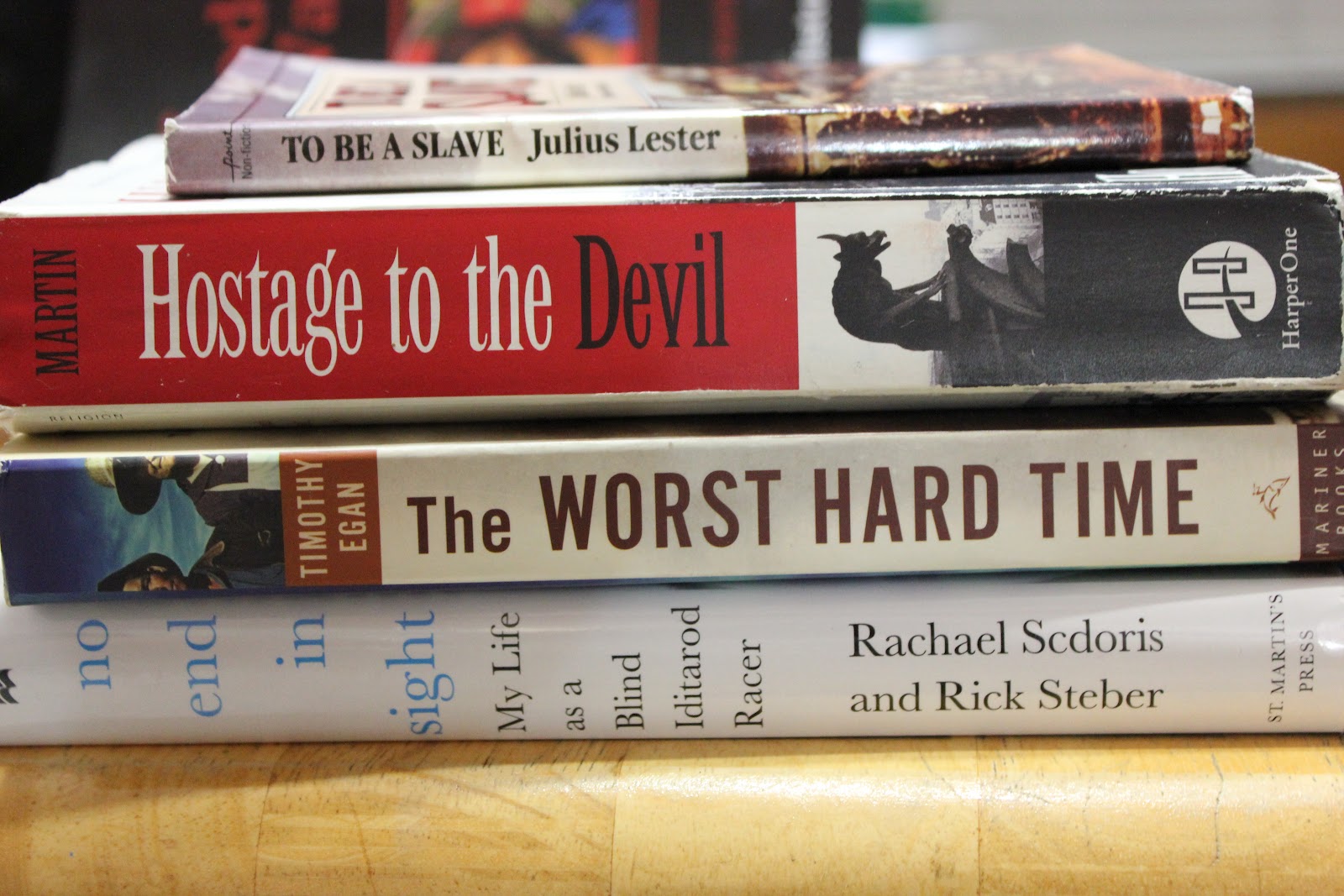
I just discovered Book Spine Poetry.Quinn McDonald described it in a blog called "Quinn Creative." You simply stack up a few books, and each title becomes a line of a poem. When I started putting my stacks together, my husband looked puzzled and finally said, "It's a good way to trick yourself into sorting the bookshelves."  Later a friend came over.  She got it right away.

I found that many books start with "The" and that gets in the way of a good poem.  Finding a book that starts with a preposition or gerund is golden.  And it works better if you ignore the subtitles.

You can "write" as many lines as you wish, but I like the sound of a four-line poem.

Here is my first attempt at Book Spine Poetry.  I'll post the photo first, followed by the poem typed out.


Two old women
Living on the edge
In the land of white death.
Snowstruck.


The everlasting man
Walking on water,
Swimming with giants,
In search of birds and wild places.


To be a slave,
Hostage to the devil,
The worst hard time,
No end in sight.


The Orthodox way,
The way of a pilgrim,
Path to sanity,
A tiny step away from deepest faith.


Wednesday, March 28, 2012

Caroline and the Brothers Dank

Here are some videos of Caroline and the Brothers Dank playing at a local coffee shop:
Fiddle Music:


South Wind:

Wagon Wheel:

Wednesday, February 1, 2012

You’re going to Name your Baby WHAT? Thoughts on Today’s Baby Names


Photo by idiahoeditor (www.morguefile.com)

Every year our newspaper publishes a special section called “Bundles of Joy.” People pay to have a picture of their baby in the paper. I peruse the section, not so much for the pictures (even though they ARE cute), but for the names.  I find it fascinating what people choose to name their offspring.

Here are my very unscientific observations based on this year’s “Bundles of Joy.”  NOTE: Ideas on baby names are extremely subjective.  I hesitated to write this article because I don’t want to offend anyone.  If I pick on a name you have chosen, I apologize.  This is only one person’s opinion.

There were a total of 134 babies featured this year (if I did my math right).  I divided them into several categories and counted the total babies with names in that category.  All examples are from this year’s “Bundles of Joy” section.

Classic Names – 9
These  are the perenniel favorites, timeless names that will always serve a child well. They were common in my generation, but not as common today.  I only noticed one girls’ name: Anne.  Boys’ names included James, Mark, Thomas, William, Andrew, and Nathaniel.

Boys Names Used for Girls – 10
This is a pet peeve of mine.  Perhaps parents are trying to give their daughter an advantage by giving her a masculine name.  But probably they just like the sound of it.  I don’t.  And what’s worse – it ruins a perfectly good boy’s name.  You probably know a man named Tracy, Stacey, Dana or even Lois.  Those names used to be men’s names, but now the poor men have to suffer through life with a woman’s name.  Here are some of the names listed this year: Parker, Maisyn (changing the spelling does NOT make it a girl’s name, thank you), Payten (ditto), Peytin (ditto), Avery, Riley, Emery (and that is (or rather WAS) such a great boy's name), Halyee, and Reece.  (Okay, Okay, there is Reese Witherspoon, but it’s still a man’s name.) Please, people.

Old-Fashioned Names - 12
These are the names of our grandparents, names our classmates would have laughed at.  But today they are appreciated as “retro.”  I like most of these names. Examples: August, Levi (ok, I don’t like that one),Titus, Veronica, Oliver, Cecelia, Theodore, Cora, Naomi, Juliet (cool!), Ava, Ella.

Trendy but “Normal” Names - 48
These are names that were practically unheard of when I was growing up, but have become commonplace today.  Most of these are now good, solid names that will serve a child well. Examples: Ethan, Karlie, Lily, Lauren, Alison, Justin, Zachary, Carter, Jackson, Katelyn, Landon.


Newbies but Goodies – 30
People are becoming more and more creative with their names – and that can be good.  Some names are made up; others are uncommon or from a unique source. I really like some of the more unusual names.  Here are some examples from this year:
Girls: Amirah, Kinley, Emilia, Vionna, Gemma, Norah, Arynn, Maya, Kinsley, Somara.
Boys: Easton (very nice), Zavian, Donovan, Kyler, Griffin (my daughter really likes this one – I have mixed feelings), Caiden, Cade, Hudson (I really like this one), Emerson.

Just Plain Odd – 25
OK, people, creative is good, but odd is, well . . . ODD!  Here are some that made me shake my head in wonder.
Girls: Isla, Atleigh, Brylee, Brooks (I like Brooke, but Brooks?), Zariyah, Danica (“sounds like yogurt,” my daughter commented), Berkeley (a city in California?), Brinlee ( what???), Honor (honor is a good thing, but a name???), Alivia (Olivia is nice, but why change the first letter?), Alexiana (now you KNOW she’s probably going to be called Lex anyway, so why bother with a five-syllable name?), Harlow (really?  A GIRL named Harlow?  I’d put it in the boy’s names category, but it doesn’t even fit there.),
Boys’ names: Gunner (I’ve heard of the Swedish name Gunnar, but GunnEr???), Brenson, Enzo (Sounds like a laundry detergent), Cruz (this baby was Caucasian, BTW), Ryder, Marek, Brogan, Maddox, Holden, Ryker, Declan (how do you pronounce that, anyway?), Duran.


Sunday, January 22, 2012

Recipe: Banana Spice Cake

Here's an easy way to use up those bananas that are getting too ripe.  Keep a box of spice cake mix on hand to use for this. (I try to buy cake mixes when they're on sale)

  • 1 box spice cake mix
  • 2-3 ripe bananas, mashed
  • 1/8 teaspoon baking soda

Empty cake mix into bowl. Add baking soda.  Mix the cake according to package directions, except reduce the water by 1/4 cup.  Add mashed bananas. Bake according to package directions. When cake is cool, frost with buttercream or cream cheese frosting.  Makes a nice, moist cake.

Review of Destination: Love and Whales

I bought this book because it's written by my friend Jeanne Kern, along with Bruce Held. It's a romance between two unlikely people from the same hometown who both end up on a whale watching trip. The other characters on the excursion are fun, and you may even learn something new about whales. It's a fun, quick read. (Note: It does have a couple of "adult" scenes.)

 You can see the books I've read so far (starting in 2011) here.

Thursday, January 19, 2012

How to Fix the Facebook Feed


Facebook is fun, but not when it decides what I want to see.  I am not a fan of the “Highlighted Stories.”  How does Facebook know what stories I want to see the most?  Often the ones I’m most interested in are not the ones I comment on. 

The Facebook Powers that Be have made it better now that we can click on “Sort” and choose “Recent Stories First.”  But it still seems like I’m missing something.  I’ve found I can control what I see on Facebook by using the List feature. 

Here’s how to make a list that will show all the updates on Facebook:
  1. Click on home.
  2. On the left, you should see some lists that have already been created.  (You may need to click on “More” to see it.)
  3. To the right of where it says Lists, click on “More.”
  4. At the top, click on “Create List”
  5. Give it a name. For this list, call it “All Friends” or “Everyone.”
  6. Click on “Create.”
  7. Click on “Add Friends”
  8. The next step is the time consuming one.  Click on every single friend you have. Make sure they are checkmarked after you click on the name.
  9. When you are done, click “Done.”
  10. Now you will see everything that the group has posted.  There is one more step. On the upper right click on “Manage List” and scroll down to “Choose Update Types.”  You can choose what you want to see from this list.  If you want to see everything, that’s fine.  But perhaps you don’t want to see updates about games, so you can unclick that.
  11. Now go back to home and look at your lists.  Do you see your “All Friends” list?  If not, click on “More.”  Hover your mouse to the left of the name and you will see a pencil icon. Click on that icon and click on “Add to Favorites.”  This will move that list to your Favorites list at the top, so you can find it more easily.  Now, whenever you log into Facebook, click on “All Friends” and you will see all the updates without any Facebook censoring.

Whenever you make a new friend on Facebook, remember to add them to the list.  You can also go back under “Manage List” and add the new friends from time to time.

Now that you know how to make a list, you may want to make other lists. You can make another list of all friends, call it “Photos” and under “Choose Update Types” choose only “Photos.” You may want to do the same with status updates.

 You can also make subgroups. You might want to make a list of people who you are most interested in (instead of letting Facebook decide what you want to see.)  Call it “News” or “Top Friends” or whatever you want. Just go through all the steps listed above, but instead of clicking on all your friends, just click on your top friends. You can make lists for various aspects of your life, such as friends from school, church, work or an organization, or simply “Old Friends.”  I also made one for Fan pages.  To do that, when you go to add friends, look at the upper left corner of the Friends Box, where it says “Friends.” Drop down and choose “Pages” instead, and you’ll see all your fan pages.  Choose all those, and you will have a list of fan pages.

You’ll find it much easier to keep up with everyone by using the lists feature. 

Tuesday, January 17, 2012

Review of the Dovekeepers

The Dovekeepers is a historical fiction book set in a unique place and time - the Jewish fortress called Masada, during the Jewish-Roman war of 70 AD. The story is told from the point of view of four women who work tending the doves, whose droppings fertilize the gardens in their fortress-village. Their lives intertwine in often surprising ways. It's a story of struggle and suffering told in beautiful language. The characters are intriguing, though their actions are not always entirely believable. But it's an interesting look at an event in history not often talked about.

 You can see the books I've read so far (starting in 2011) here.

Monday, January 2, 2012

Grammar Tip #3: “Mary and I” or “Mary and me”?


For some reason most people always use “Mary and I” (or “he and I” or “she and I,” etc.) in a sentence, no matter where the phrase lies.  So they end up saying something like this: “Mary and I went for a walk. A cop gave Mary and I a ticket for jaywalking.”

The first sentence is correct, but the second sentence is incorrect.  Why? In grammatical terms, the rule goes like this: Use “Mary and I” when the phrase is the subject of the sentence, and use “Mary and me” when the phrase is the object of a verb or preposition.  But that might as well be a foreign language to some people.

It is helpful to note that “Mary and I” often comes at the beginning of a sentence, while “Mary and me” comes in the middle or at the end of a sentence.  But that doesn't always work.

The best way I’ve found to determine which to use is simply to take out the “Mary and.”  Then read the sentence and see what sounds better.  Thus: “I went for a walk” sounds good, but “A cop gave I a ticket for jaywalking” sounds odd.  It should be “A cop gave me a ticket for jaywalking.”  Thus we should use, “A cop gave Mary and me a ticket for jaywalking.”

Here are some more examples:

He and I both like to eat sour apples.
It seems to her and me that we should turn left here.
On Friday, Sarah and I went to the movies.
Don’t tell Fred and me what to do.

Thursday, December 29, 2011

Review of Fyodor Dostoevsky by Peter Leithart


As a recent convert to Eastern Orthodox Christianity, I was interested in learning more about Fyodor Dostoevsky, an Orthodox Christian writer who lived in Russia from 1821-1881. I admit that I’ve never ready any of Dostoevsky’s works, but my daughters list his Crime and Punishment among their favorite books. I decided to read this biography to learn more about him.

As is true of many artists, Dostoevsky was a tortured soul, in more ways than one. He suffered from epilepsy and other ailments, experienced profound loneliness at times, and was unfaithful in marriage. Because of his political views, he was sent to a prison camp in frigid Siberia. It was there that his faith took root, and this faith became a central part of his novels. Though he achieved success as a novelist, he struggled financially all his life. The final chapter tells of a moment of victory he experienced during a speech he gave honoring the Russian poet Pushkin.

The author uses fiction techniques to tell the story of Dostoevsky in an interesting way.  The story comes out in bits and pieces, through conversations, recollections and flashbacks.  I found myself confused at points, and more than once I wished the author had told the story in a chronological, linear format.

I found Dostoevsky a fascinating character, and I learned a lot about a little-known period of Russian history. Perhaps it’s my turn to read Crime and Punishment.

NOTE: I received a complimentary copy of this book from Booksneeze. The opinions expressed are my own.

 You can see the books I've read so far (starting in 2011) here.

Friday, December 16, 2011

Major 2012 Sled Dog Races in Alaska - Mostly Mid-Distance and Long-Distance Dogsled Races

The following are the major sled dog races in Alaska.  Click on the name of each race to go to the website for the race.  See my previous post for a handy chart in pdf form that you can print out.


Sheep Mountain 150 - Dec. 17, 2011

Alaska Excursions 120 - Dec. 17, 2011

Gin Gin 200 -  Dec. 28, 2011

Knik 200  - Jan. 7, 2012

Copper Basin 300 - Jan. 14, 2012

Kuskokwim 300* - Jan. 20, 2012

Northern Lights 300 - Jan. 27, 2012

Don Bowers 200 - Jan. 27, 2012

Tustemena 200 - Jan. 28, 2012

Yukon Quest - Feb. 4, 2012

Fur Rendezvous - Feb. 24, 2012

Junior Iditarod - Feb. 25, 2012

Iditarod - Mar. 3, 2012

Percy DeWolfe  - Mar. 22, 2012

Kobuk 440 - Apr. 12, 2012

*Includes Bogus Creek

Thursday, December 15, 2011

2012 Sled Dog Races - A Chart for Following the Races

It's almost time for Sled Dog Racing season!  The first two races start this weekend.  Following the races online adds so much excitement to the long winter days.  I've made a chart for following the major races in Alaska.  This is by no means an exhaustive list; but it includes most of the mid-distance races, the two distance races (Iditarod and Yukon Quest) and the Fur Rondy.  Simply follow this link and print out the pdf.  The chart includes the name of the race, the start date, the website (which you can click to follow) and another blank, which you may use how you wish.  You may use the blank to fill in your favorite musher, the winner, or whatever you wish to remember about the race.

Click here for the chart.

Happy race season!

Saturday, December 3, 2011

Velvet Shoes - "Let us walk in the white snow."


We had our first snow today, and I went walking in the falling snow. It reminded me of the poem "Velvet Shoes," by Elinor Wylie.  Some say this poem has symbolism of love and marriage. To me, it's just a good example of poetry.  I use it in my poetry writing class to demonstrate excellent use the poetic elements of simile, metaphor, alliteration, repetition, unusual words together (i.e., white silence), and involving all the senses.

Because this poem was written in 1921, it is in the public domain.  I have illustrated it with photos that I took during today's walk.


Velvet Shoes
Let us walk in the white snow
In a soundless space;
With footsteps quiet and slow,
At a tranquil pace,
Under veils of white lace.

I shall go shod in silk,
And you in wool,
White as white cow’s milk,
More beautiful
Than the breast of a gull.

We shall walk through the still town
In a windless peace;
We shall step upon white down,
Upon silver fleece,
Upon softer than these.

We shall walk in velvet shoes;
Wherever we go
Silence will fall like dews
On white silence below.
We shall walk in the snow.


Thursday, November 24, 2011

Grammar Tip #2: Its vs. It’s


This is another one of my pet peeves. As more and more people rely on spell checkers instead of editors, this type of mistake is becoming commonplace.

It can be confusing, but it really is quite simple.  Here is the basic rule:

Use it’s (with an apostrophe) when you mean it is or it has.  In this case, the word it’s is a contraction, like isn’t or won’t.

Examples
It’s a beautiful day.
I like this movie because it’s funny.
It's been a long winter.

Use its (without an apostrophe) when you mean belonging to it.  In this case, the word its is a pronoun (possessive pronoun to be exact), like the word his or her.

Examples
The cat licked its fur.
Nebraska is known for its friendly people.
Hard work has its rewards.

If it helps, you can ask yourself this question: Can I substitute his or her for its in the sentence (even though it may not quite make sense).

For instance, although it doesn't totally make sense, you could say
The cat licked her fur.
Nebraska is known for his friendly people.
Hard work has her rewards.


But it would be ridiculous to say:
His a beautiful day.
I like this movie because her funny.
His been a long winter.

The usage of its can be especially confusing because if you were to use the noun instead of its, you would use an apostrophe: “the cat’s fur,” “Nebraska’s friendly people,” “hard work’s rewards.”  But think again of the words his and her, or other possessive pronouns: my, your, our, their. None of them use an apostrophe.  Because its is a possessive pronoun, it does not have an apostrophe either.

Grammar Tip #1: Everyday vs. Every Day


The incorrect use of everyday as one word has become one of my pet peeves.  I see it in print all the time.  Because a spellchecker doesn’t know how the word is used, it accepts everyday as one word all the time.  This simple rule will help you determine when to use everyday as one word and when to use two words: every day.

Use one word when everyday is used an adjective, that is, when it comes right before a noun and answers the question, “What kind?”

Examples
These are my everyday shoes.
Running into people I know is an everyday happening for me.
Let’s use the everyday tablecloth.

Use two words when every day is used as an adverb, that is, when it answers the question, “how often?” It often comes after the verb, but it can come at the beginning of a sentence too.

Examples
I walk to work every day.
Take this vitamin every day.
Every day we have this same conversation.


Monday, November 21, 2011

A Poem about November


Few poets want to write about November.  It’s just not the stuff of poetry.  So I decided to write one myself.  I’ve become a fan of blank verse lately, so that is the style I chose. Its 14 lines will remind you of a sonnet as well.

November

November days are not the stuff of poems.
The chilling rain from dreary cloudy skies,
Too late for farmers to be glad it’s there,
Not cold enough to snow, so what’s the use?

The reds and yellows that we all admired
Have given way to brown and barren boughs
And endless piles of leaves to put in bags
And line the streets to wait for garbage trucks.

In recent years November has become
The month to write that novel long neglected.
Nothing else to do but stay inside
And wait for snow and coming Christmas joys.

The month seems like a comma or a dash
That serves no purpose but to slow us down.

Review of Eerie Erie by Robin S. Swope a.k.a. the Paranormal Pastor

I had no idea that Erie, Pennsylvania, is the home of haunted places, UFO sightings, historical mysteries and strange creatures. Pastor Robin Swope has become an expert in all things paranormal, and has developed quite a following on his blog, The Paranormal Pastor. His book is well researched and well written. I was especially intrigued by the stories of the thunderbird, as I was not familiar with this legend. The first part of the book moves a little slowly, but be patient; it gets better. Unlike his first book,True Tales of the Unexplained, Eerie Erie has no typos or errors (that I noticed) and reads like a book, not a series of blog posts.

You can see the books I've read so far (starting in 2011) here.

Saturday, November 5, 2011

Review of Hostage to the Devil by Malachi Martin


This book relates the true stories of five exorcisms performed in the 70s. The stories are told in a fictional format with lots of detail. It's a fast read, but I had to stop halfway through and take a break, since the incidents were disturbing and a bit vulgar at times. In addition to detailing the history of the possessed and how they opened their hearts to the demonic, the book gives the history of each of the priests who did the exorcisms.  It's chilling, but the good wins out in the end, though not without a struggle.

You can see the books I've read so far (starting in 2011) here.

Sunday, October 30, 2011

Review of Atheist Delusions

This book is written as a response to "The God Delusion" and some of the other books by the "new atheists." It focuses on the history of Christianity and takes on some of the typical arguments that atheists use. It's not easy reading, but I did learn a lot through this book.


You can see the books I've read so far (starting in 2011) here.

Tuesday, October 18, 2011

Two Favorite October Poems


I love October. There's something about it that makes people want to write poetry.  Two of my favorite poems are about October.  I've combined these two autumn poems with some original photos, most of which were taken in my own neighborhood.  (These poems are both old enough to be in the public domain, so there is no copyright infringement.)

A Vagabond Song
by Bliss Carman


There is something in the autumn that is native to my blood—
Touch of manner, hint of mood;
And my heart is like a rhyme,
With the yellow and the purple and the crimson keeping time.

The scarlet of the maples can shake me like a cry
Of bugles going by.
And my lonely spirit thrills
To see the frosty asters like a smoke upon the hills.


There is something in October sets the gypsy blood astir;
We must rise and follow her,
When from every hill of flame
She calls and calls each vagabond by name.


October
by Robert Frost

O hushed October morning mild,
Thy leaves have ripened to the fall;
To-morrow’s wind, if it be wild,
Should waste them all.
The crows above the forest call;      
To-morrow they may form and go.
O hushed October morning mild,
Begin the hours of this day slow,
Make the day seem to us less brief.
Hearts not averse to being beguiled,      
Beguile us in the way you know;
Release one leaf at break of day;
At noon release another leaf;
One from our trees, one far away;
Retard the sun with gentle mist;      
Enchant the land with amethyst.
Slow, slow!
For the grapes’ sake, if they were all,
Whose leaves already are burnt with frost,
Whose clustered fruit must else be lost—      
For the grapes’ sake along the wall.


Friday, October 14, 2011

The Sociology of Earbuds


Earbuds (and the iPods/mp3 players attached to them) have changed the world. I admit, I’m guilty myself. While walking my dog or commuting on the bus, I get bored. I’m not much for music in my ear. (I prefer to listen to music in the air, not through earbuds.) But I love podcasts.  For me it’s mostly recordings from AncientFaith Radio and occasionally Mushing Magazine.  (Yeah, I’m a bit odd.)

Here we are, crammed in a bus, but no one communicates. I sit next to someone, so close that we have to tense up to keep from touching, but yet neither one acknowledges the other; we both are in the world of our recordings.  It’s just not right.

So sometimes I rebel. I’ve made friends with the morning bus driver. We’re usually the only ones talking on the bus. I’m not sure what the others think of our chattering.  But the driver tells me she looks forward to picking me up each day.

But I still plug in on my evening commute. A couple of days ago I sat down and plugged in as usual. A young woman sat close to me. I smiled at her. I recognized her from somewhere.  But I was already plugged in, so I didn’t say anything.  Then the bus stopped and waited while a young girl gathered her musical instrument and backpack and got off the bus. We watched her, our eyes showing our concern for the young girl riding the bus alone.

When she had gotten off, I paused my podcast, looked at the young woman and said, “She seems kind of young to riding the bus by herself.”

That comment started a conversation.  I asked the young woman where I knew her from, and she said it was just from the bus. (I still think I know her from somewhere else, perhaps the Table, where I eat lunch frequently, but she could be right.) We exchanged names, I asked her what she was studying, she asked about my job, where I lived, what I was listening to. I made a new friend on the bus, and I look forward to seeing her again. 

What a concept: Making a new friend on the bus. It used to happen all the time; but now it’s an oddity.  And it makes me concerned for the future of our society.
Maybe I’ll unplug more often.

Review of Faith Reborn: A Personal Apologetics

I love true stories. Telling a story - especially a true story or testimonial - is one of the best ways to communicate. This story of a man's recovery of faith is told from the heart. But it's more than a story. It's an explanation of some of the best reasons for the Christian faith. I recommend it for anyone who is struggling to believe.


You can see the books I've read so far (starting in 2011) here.

Review of Spiritual Anorexia: How Contemporary Worship Is Starving the Church

I urge everyone to read this book. It will open your eyes to what is ailing today's church. This book is a welcome change from the modern "seeker friendly" philosophy that pervades our churches. If we worship a holy God, then our worship needs to reflect that. The modern church is missing out on a rich and beautiful tradition that dates back two thousand years to the time of Christ and the apostles. Reading this book will introduce you to that tradition and bring a fresh perspective on the meaning of worship.

 You can see the books I've read so far (starting in 2011) here.

True Tales of the Unexplained Book Review

True Tales of the Unexplained Book Review
A pastor writing about ghosts, UFOs, werewolves, demons and other paranormal manifestations? Sounds impossible? Not when the author is Robin Swope, the "paranormal pastor," whose blog has an avid following. This book is an easy--and interesting--read. It also suffers from the lack of editing so common in most self-published books, including some spots where it's obvious that the writing first appeared in a blog. But if you can look past those flaws, you'll find a fascinating book.

You can see the books I've read so far (starting in 2011) here.

That's One Determined Dog

Another great dog video I found. We could all learn something from Gus's determination.

Saturday, August 13, 2011

I invented the iPad in 1970


Move over, Al Gore. You may have invented the internet, but I invented the iPad, the iPhone and the many other tablet devices that are coming out.

It really should be called the “Zhing Thing.”

I was in fifth grade. My school friends and I would soon be too old to play pretend, but I still wanted to hang on to that childhood joy. Plus, I hated sports. I still wanted to play pretend at recess, and I wanted my friends to join me. But at that age, I knew I needed to come up with something more interesting than house or pioneers.

So we were aliens from the planet Zhingm. A favorite hollowed out corner of the playground filled with weed trees (dubbed “The Hole”) became our spaceship. The rest of the grassy lot became the various planets we visited. We inhaled our food (called Chigamabobolu, with a soft ch pronounced like sh) and took in oxygen by osmosis instead of breathing. I called myself Chemey (soft ch again), and my friends followed suit with Chimey, Chomey, Chumey, etc.

Zhingm was new, sophisticated, and reminded everyone of Star Trek, which was current then. It was cool enough to draw most of the girls in my class away from sports, even if for a little while. And that made me happy.


Drawing from the Star Trek communicator idea, I came up with the “Zhing Thing.” The Zhing Thing was a multipurpose device we carried with us everywhere. I made mine out of a Good and Plenty candy box covered with paper. On it I drew all the different things that this amazing machine could do. Besides being a mobile phone (more of a walkie talkie type device, I think), it included a camera, tape recorder, TV, radio, record player, and possibly a weapon-type device. I don’t remember what else included, but it was pretty amazing.

I couldn’t even imagine videos at that time, much less a portable computer, and certainly not the internet. I couldn’t even imagine a portable calculator. But I did imagine carrying around a small device that could do multiple things. At that time, it seemed like the stuff of science fiction, something only aliens would be advanced enough to figure out. I never dreamed it would happen in my lifetime.

Now if only I could sue Apple for patent infringement.

Wednesday, August 10, 2011

Heady Waters Book Review


Heady Waters has all the elements of a good murder mystery - a bizarre killing, quirky characters, intrigue, a bit of romance -- all while wondering "who done it?" The author's legal expertise brings authenticity to his first novel, and the Nebraska setting is a refreshing change. Sure, there are a few typos and grammar/usage problems, commonly seen in self-published pieces, and the Kindle version has some formatting glitches. But overall, it's a good, entertaining read.

You can see the books I've read so far (starting in 2011) here.

Tuesday, July 26, 2011

Murder on the Yukon Quest Book Review


I don't read much fiction, but hey, this one's about mushing so I had to read it. I read her book Murder on the Iditarod Trail several years ago and enjoyed it, so I decided to pick this one up. It's a good old-fashioned murder mystery, but it's set during the Yukon Quest, a 1000 mile race from Whitehorse, Yukon, to Fairbanks, Alaska. The checkpoints and race info was accurate, but because it was a work of fiction, the mushers were all fictional, which was a bit unnerving. However, I took comfort that one of the dogs in the race was named Silver. That's the name of Brent Sass's lead dog. Brent has attained hero status for rescuing other mushers, and he gives all the credit to Silver.

You can see the books I've read so far (starting in 2011) here.

Thursday, July 7, 2011

Heaven is For Real Book Review


I just finished reading Heaven is for Real: A Little Boy's Astounding Story of His Trip to Heaven and Back.  This readable and engaging book tells the true story of a little boy's near death experience during an appendectomy. Several months after his surgery, three-year-old Colton began telling his parents bits and pieces of what he saw in heaven. Many of the anecdotes defy explanation. For instance, Colton told his parents that he had a sister in heaven. His mother had had a miscarriage but hadn't told Colton. You can see the books I've read so far (starting in 2011) here.